Xinzhao Chu
Professor of Aerospace Engineering Sciences

- Ph.D., Peking University, Beijing, 1996
Research Interests
My research goal is to explore unknowns in the atmosphere, space, and beyond. My group works to explore advanced spectroscopy principles and develop new lidar technologies to push detection limits and make new discoveries. By making measurements with unprecedented accuracy, resolution, and coverage, we study the fundamental physical and chemical processes that govern the structures and dynamics of the whole atmosphere, and advance the understanding of the universal processes in the Earth’s space-atmosphere interaction region and how they shape the atmospheres of Earth-like planets. In our quest to develop whole-atmosphere lidar and to explore the unmapped, we also aim to realize the full potential of lidar, making practical use of it to serve the world.
Current Research
Lidar marathons in Antarctica and plasma-neutral atmosphere coupling
Discoveries of thermospheric neutral iron (Fe) layers (Chu et al., Geophys. Res. Lett., 2011), solar effects on Fe layer bottomside (Yu et al., J. Geophys. Res., 2012), persistent inertia-gravity waves (Chen et al., J. Geophys. Res., 2013), and super-exponential growth of thermal tide amplitude above 100 kilometers (Fong et al., J. Geophys. Res., 2014) by lidar observations in Antarctica are challenging our understanding of electrodynamics, neutral dynamics, chemistry, composition, and energetics in Earth’s geospace environment. CIRES students Zhibin Yu and Weichun Fong in the Chu research group are developing numerical models to study the mechanisms. We achieved initial success, having successfully modeled the thermospheric Fe layers after carefully considering the neutral-plasma coupling and the influences of polar electric field, vertical wind, and aurora activity (see figure). These science discoveries are motivating the atmosphere and space science community with a new initiative, Observatory for Atmosphere Space Interaction Studies (OASIS).
This also has been a year of setting records. The CIRES lidar team set a historic record for lidar observations: a continuous 174 hours of observations from Dec. 29, 2013, to Jan. 6, 2014, in Antarctica. CIRES student Cao Chen set new records, making continuous, sole-operator, 53- and 65-hour lidar observations in the harsh Antarctic winter. CIRES student John Smith and CIRES researcher Wentao Huang achieved lidar signal levels of 2,400 counts per shot at Boulder, Colorado. These long and very high-resolution data sets are invaluable in pushing the envelope of upper atmosphere sciences. Another unprecedented record: CIRES students in the Chu group have won prizes every year from 2009 to 2014 in the Coupling, Energetic, and Dynamics of Atmospheric Regions (CEDAR) Student Poster Competition— most recently Zhibin Yu in 2013 and Weichun Fong in 2014. CIRES researcher Xian Lu won a CEDAR grant as the principal investigator for the first time. Congratulations to these creative students and researchers!
Research Categories
Atmosphere, Cryosphere, SpaceResearch Images
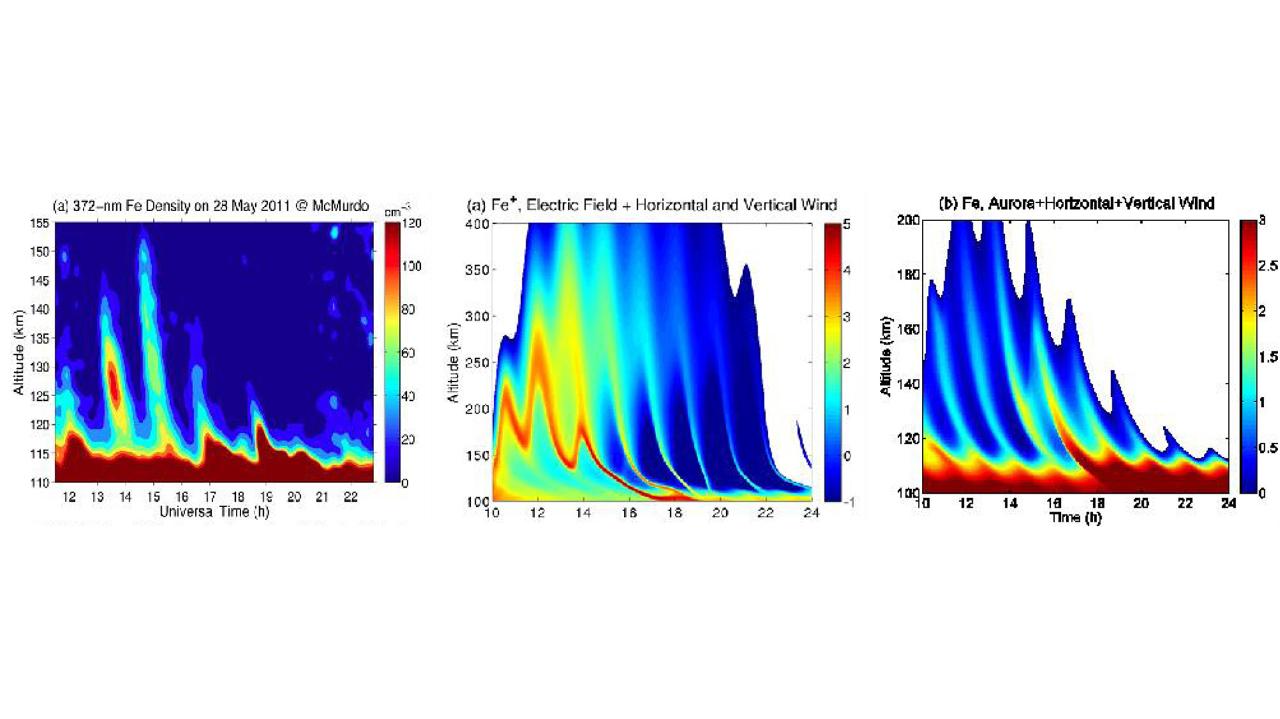
Thermospheric Iron
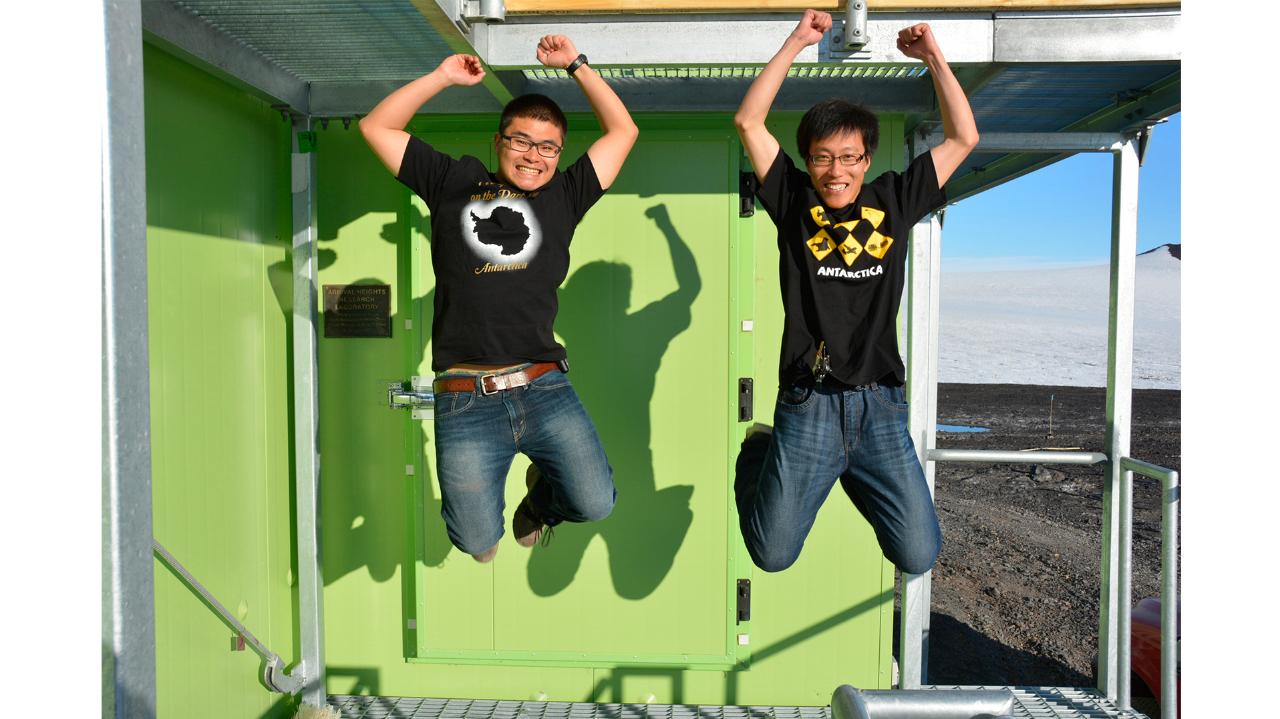
Arrival Heights Lidar Observatory
to
Invalid date -Sponsors
-
Invalid dateP.I.(s)
About CECA
CECA connects and creates a supportive environment for graduate students and postdocs who come from various academic units to do research in CIRES.