

Cooperative Institute for Research in Environmental SciencesCooperative Institute for Research in Environmental Sciences at the University of Colorado Boulder
Xinzhao Chu group
We use lidar to explore the atmosphere, space and beyond
Xinzhao Chu group
We use lidar to explore the atmosphere, space and beyond
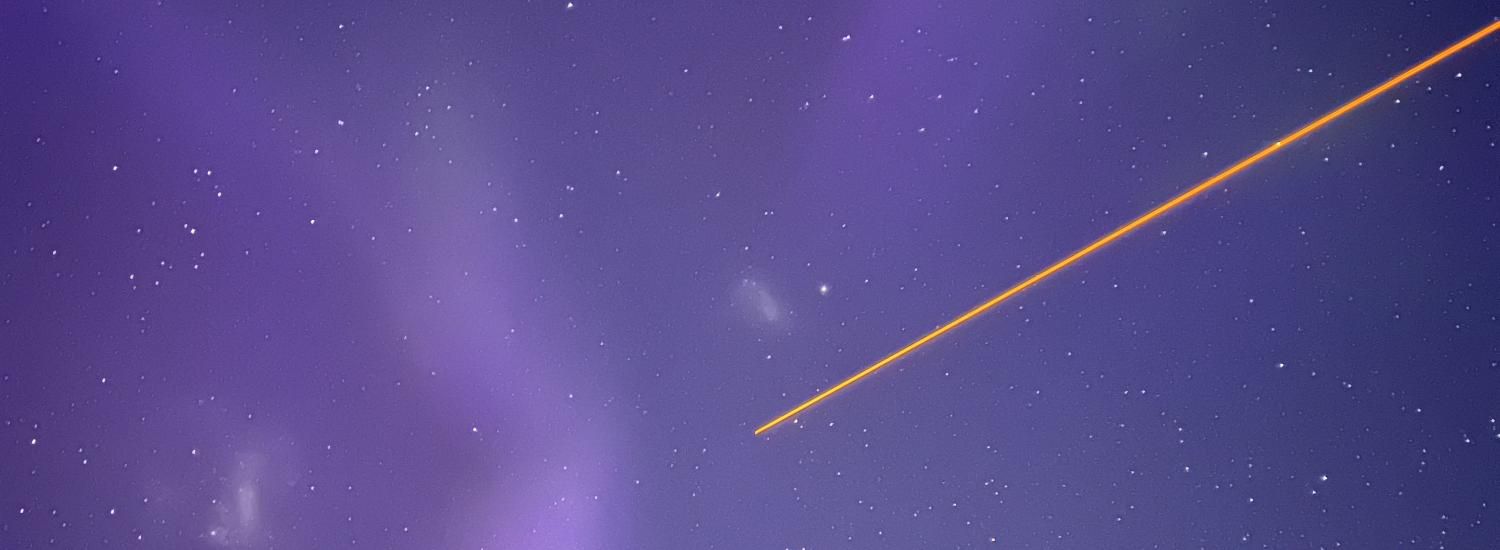
Lidar in the night sky in Antarctica, December 2022.
We explore advanced spectroscopy principles, develop new lidar technologies, study the fundamental physical and chemical processes that govern the whole atmosphere, and make new discoveries in the atmosphere-space sciences.
We're recruiting! Join our world-class LIDAR team.

THIS IS AN ENERGETIC GROUP! MANY MEMBERS HAVE TRAVELED TO THE END OF THE WORLD TO MAKE LIDAR OBSERVATIONS IN ANTARCTICA. TWO OF THEM (ZHIBIN YU AND BRENDAN ROBERTS) HAVE BRAVED THROUGH THE HARSH ANTARCTIC WINTERS IN 2011 AND 2012!
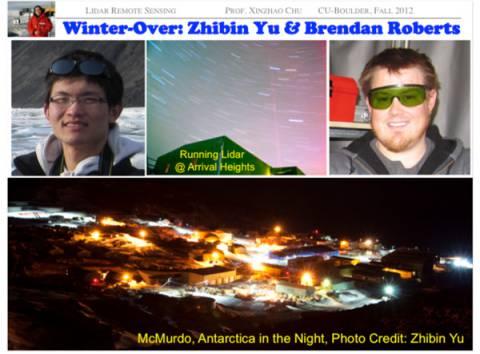
WE ARE EXCITED NOT ONLY BY THE BEAUTIFUL PENGUIN AND AURORA, BUT ALSO BY THE NEW SCIENCE DISCOVERIES WE HAVE MADE IN THE POLAR THERMOSPHERE, MESOSPHERE AND STRATOSPHERE FROM THE MCMURDO LIDAR DATA. MORE DETAILS CAN BE FOUND IN OUR PUBLICATIONS.
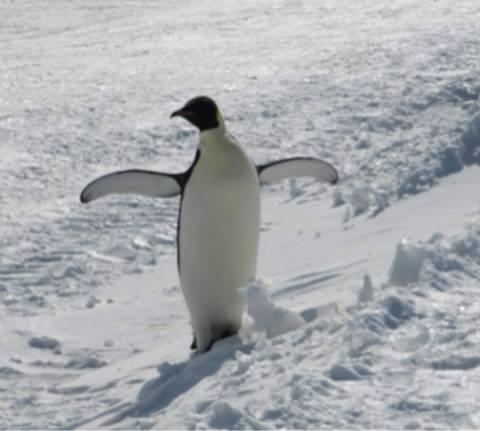
AN EMPEROR PENGUIN AT PEGASUS AIRPORT NEAR MCMURDO
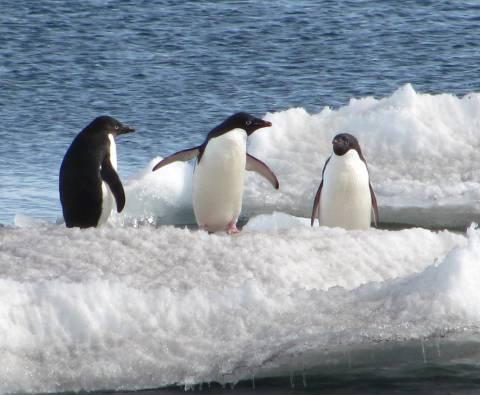
THREE ADELIE PENGUINS CHATTING AT THE MCMURDO SOUND
Boulder is home to a vibrant community of scientists and engineers and houses some of the world's most renowned environmental science institutes and facilities. Many of our residents allow this exploratory spirit to carry over into their free time, with vast expanses of open space in and around the community for hiking, biking, skiing and other outdoor activities.
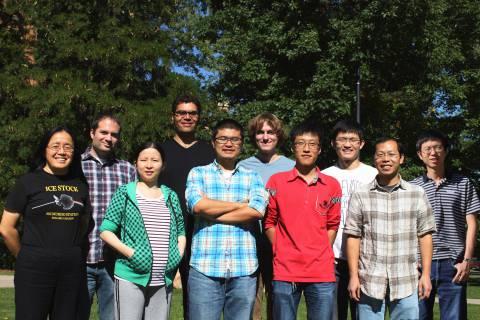
BESIDES MAKING NEW SCIENCE DISCOVERIES, THESE CREATIVE RESEARCHERS ARE ALSO EXCITED BY MAKING INNOVATIONS IN LIDAR TECHNOLOGIES AND DEVELOPING THE NEXT-GENERATION LIDAR INSTRUMENTS. CURRENTLY, SEVERAL NEW LIDARS ARE BEING DEVELOPED ON OUR CAMPUS IN BOULDER.
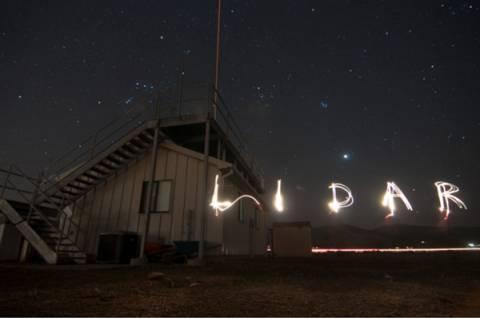
CREATIVE STUDENTS ZHIBIN YU AND JOHN A. SMITH “PAINTED” LIDAR WITH THE STAR NA DOPPLER LIDAR AT THE TABLE MOUNTAIN LIDAR FACILITY, NORTH OF BOULDER.
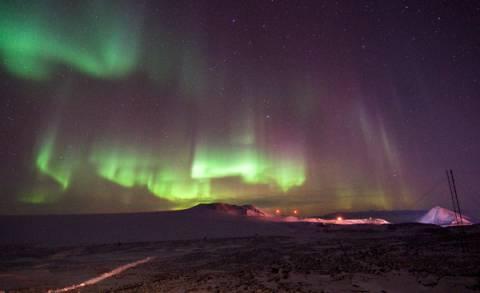
SPECTACULAR AURORA DISPLAY OVER ARRIVAL HEIGHTS NEAR MCMURDO, ANTARCTICA WHEN ZHIBIN YU WAS OPERATING OUR FE BOLTZMANN LIDAR THERE ON MAY 28, 2011
We always welcome new members and scientific collaborations! Together we explore the atmosphere–space interactions with lidar observations and numerical modeling.
2016
Smith, J. A., and X. Chu, Investigation of field-widened Mach-Zehnder receiver to extend Fe Doppler lidar wind measurements from the thermosphere to the ground, Applied Optics, Vol. 55,Issue 6, pp. 1366-1380, doi: 10.1364/AO.55.001366, 2016. [PDF reprint]
Chen, C., X. Chu, J. Zhao, B. R. Roberts, Z. Yu, W. Fong, X. Lu, and J. A. Smith, Lidar observations of persistent gravity waves with periods of 3-10 h in the Antarctic middle and upper atmosphere at McMurdo (77.83°S, 166.67°E), J. Geophys. Res. Space Physics, 121, 1483-1502, doi:10.1002/2015JA022127, 2016. [PDF reprint]
2015
Gao, Q., X. Chu, X. Xue, X. Dou, T. Chen, and J. Chen, Lidar observations of thermospheric Na layers up to 170 km with a descending tidal phase at Lijiang (26.7N, 100.0E), China, J. Geophys. Res. Space Physics, 120, doi: 10.1002/2015JA021808, 2015. [PDF reprint]
Abari, C. F., X. Chu, R. M. Hardesty, and J. Mann, A re-configurable all-fiber polarization-diversity coherent Doppler wind lidar, Applied Optics,doi: 10.1364/AO.54.008999, 2015. [PDF reprint]
Lu, X., C. Chen, W. Huang, J. A. Smith, X. Chu, T. Yuan, P.-D. Pautet, M. J. Taylor, J. Gong, and C. Y. Cullens, A coordinated study of 1-h mesoscale gravity waves propagating from Logan to Boulder with CRRL Na Doppler lidars and temperature mapper, J. Geophys. Res.-Atmos., doi:10.1002/2015JD023604, 2015. [PDF reprint]
Tsuda, T, X. Chu, T. Nakamura, M. Ejiri, T. Kawahara, Y. Yikimatu, and K. Hosokawa, A thermospheric Na layer event observed up to 140 km over Syowa Station (69.0S, 39.6E) in Antarctica, Geophys. Res. Lett., 42, 3647-3653, doi: 10.1002/2015GL064101, 2015. [PDF reprint]
Lu, X., X. Chu, W. Fong, C. Chen, Z. Yu, B. R. Roberts and A. J. McDonald, Vertical Evolution of Potential Energy Density and Vertical Wavenumber Spectrum of Antarctic Gravity Waves from 35 to 105 km at McMurdo (77.8°S, 166.7°E), J. Geophys. Res. Atmos., 120, 2719-2737, doi:10.1002/2014JD022751, 2015. [PDF reprint]
Smith, J. A., and X. Chu, High-efficiency receiver architecture for resonance-fluorescence and Doppler lidars, Applied Optics, Vol. 54, Iss. 11, pp. 3173-3184, doi: 10.1364/AO.54.003173, 2015.[PDF reprint]
Fong, W., X. Chu, X. Lu, C. Chen, T. J. Fuller-Rowell, M. Codrescu, and A. D. Richmond, Lidar and CTIPe model studies of the fast amplitude growth with altitude of the diurnal temperature 'tides' in the Antarctic winter lower thermosphere and dependence on geomagnetic activity, Geophys. Res. Lett., 42, doi: 10.1002/2014GL062784, 2015. [PDF preprint]
Huang, W., X. Chu, C. S. Gardner, J. D. Carrillo-Sánchez, W. Feng, J. M. C. Plane, and D. Nesvorný, Measurements of the vertical fluxes of atomic Fe and Na at the mesopause: Implications for the velocity of cosmic dust entering the atmosphere, Geophys. Res. Lett., 42, doi:10.1002/2014GL062390, 2015. [PDF preprint]
2014
Smith, J. A., and X. Chu, High-efficiency receiver architecture for resonance-fluorescence and Doppler lidars, submitted to Applied Optics, Nov. 2014.
Fong, W., X. Lu, X. Chu, T. J. Fuller-Rowell, Z. Yu, B. R. Roberts, C. Chen, C. S. Gardner, and A. J. McDonald (2014), Winter temperature tides from 30 to 110 km at McMurdo (77.8°S, 166.7°E), Antarctica: Lidar observations and comparisons with WAM, J. Geophys. Res. Atmos., 119, 2846-2863, doi: 10.1002/2013JD020784. [PDF reprint]
2013
Yamashita, C., H.-L. Liu, X. Chu, and P. Bechtold, Physical mechanisms of gravity wave variations associated with the 2009 stratospheric sudden warming, Journal of Geophysical Research, submitted, May 2013.
Lu, X., X. Chu, T. Fuller-Rowell, L. Chang, W. Fong, and Z. Yu, Eastward propagating planetary waves with periods of 1-5 days in the winter Antarctic stratosphere as revealed by MERRA and lidar, J. Geophys. Res. Atmos., 118, 9565-9578, doi: 10.1002/jgrd.50717, 2013. [PDF reprint]
Huang, W., X. Chu, C. S. Gardner, Z. Wang, W. Fong, J. A. Smith, and B. Roberts, Simultaneous, common-volume lidar observations of mesospheric Fe and Na layers at Boulder Table Mountain (40.13°N, 105.24°W), Colorado, J. Geophys. Res. Atmos., 118, 8748-8759, doi:10.1002/jgrd.50670, 2013. [PDF reprint]
Chen, C., X. Chu, A. J. McDonald, S. L. Vadas, Z. Yu, W. Fong, and X. Lu, Inertia-gravity waves in Antarctica: A case study with simultaneous lidar and radar measurements at McMurdo/Scott Base(77.8S, 166.7E), J. Geophys. Res. Atmos., 118, doi: 10.1002/jgrd.50318, 2013. [PDF reprint]
Friedman, J. S., X. Chu, C. Brum and X. Lu, Observation of a thermospheric descending layer of neutral K over Arecibo, Journal of Atmospheric and Solar-Terrestrial Physics, 10.1016/j.jastp.2013.03.002, 2013. [PDF reprint]
2012
Yu, Z., X. Chu, W. Huang, W. Fong, and B. R. Roberts, Diurnal variations of the Fe layer in the mesosphere and lower thermosphere: Four season variability and solar effects on the layer bottomside at McMurdo (77.8°S, 166.7°E), Antarctica, Journal of Geophysical Research, 117, D22303, doi: 10.1029/2012JD018079, 2012. [PDF reprint]
Tan, B., X. Chu, H.-L. Liu, C. Yamashita, and J. M. Russell III, Zonal-mean global teleconnection from 15 to 110 km derived from SABER and WACCM, J. Geophys. Res., 117, D10, doi:10.1029/2011JD016750, 2012. [PDF reprint]
Friedman, J. S., D. Maldonado, I. González, J. Lautenbach, X. Chu, J. A. Smith, and W. Huang, High spectral resolution test and calibration of an ultra-narrowband Faraday anomalous dispersion optical filter for use in daytime mesospheric resonance Doppler lidar, Journal of Atmospheric and Solar-Terrestrial Physics, 80, 187–194, 2012. [PDF reprint]
2011
Chu, X., Z. Yu, C. S. Gardner, C. Chen, and W. Fong (2011), Lidar observations of neutral Fe layers and fast gravity waves in the thermosphere (110-155 km) at McMurdo (77.8°S, 166.7°E), Antarctica, Geophys. Res. Lett., 38, L23807, doi: 10.1029/2011GL050016. [PDF reprint]
Chu, X., W. Huang, W. Fong, Z. Yu, Z. Wang, J. A. Smith, and C. S. Gardner, First lidar observations of polar mesospheric clouds and Fe temperatures at McMurdo (77.8°S, 166.7°E), Antarctica, Geophys. Res. Lett., 38, L16810, doi: 10.1029/2011GL048373, 2011. [PDF reprint]
Gardner, C. S., X. Chu, P. J. Espy, J. M. C. Plane, D. R. Marsh, and D. Janches, Seasonal variations of mesospheric Fe layers at Rothera, Antarctica (67.5°S, 68.0°W), Journal of Geophysical Research, 116, D02304, doi: 10.1029/2010JD014655, 2011. [PDF reprint]
2010
Wang, Z., Z. Liu, L. Liu, S. Wu, B. Liu, Z. Li, and X. Chu, Iodine-filter-based mobile Doppler lidar to make continuous and full-azimuth-scanned wind measurements: Data acquisition and analysis system, data retrieval methods, and error analysis, Applied Optics, 49(36), 6960-6978, 2010.[PDF reprint]
McDonald, A. J., B. Tan, and X. Chu, Role of gravity waves in the spatial and temporal variability of stratospheric temperature measured by COSMIC/FORMOSAT-3 and Rayeligh lidar observations, Journal of Geophysical Research, 115, D19128, doi: 10.1029/2009JD013658, 2010. [PDF reprint]
Yamashita, C., H.-L. Liu, and X. Chu, Gravity wave variations during the 2009 stratospheric sudden warming as revealed by ECMWF-T799 and observations, Geophysical Research Letters, 37, L22806, doi: 10.1029/2010GL045437, 2010. [PDF reprint]
Yamashita, C., H.-L. Liu, and X. Chu, Responses of mesosphere and lower thermosphere temperatures to gravity wave forcing during stratospheric sudden warming, Geophysical Research Letters, 37, L09803, doi: 10.1029/2009GL042351, 2010. [PDF reprint]
2009
Smith, J., X. Chu, W. Huang, and B. Tan, Applications of spectral analysis and filter design in laser frequency locking system for Na Doppler lidars, Optical Engineering, 48(10), 104301, 2009. [PDF reprint]
Friedman, J. S., X. Zhang, X. Chu, and J. Forbes, Longitude Variations of the Solar Semidiurnal Tides in the Mesosphere and Lower Thermosphere at Low Latitudes Observed from Ground and Space, Journal of Geophysical Research, 114, D11114, doi: 10.1029/2009JD011763, 2009. [PDF reprint]
Yamashita, C., X. Chu, H.-L. Liu, P. J. Espy, G. J. Nott, and W. Huang, Stratospheric gravity wave characteristics and seasonal variations observed by lidar at the South Pole and Rothera, Antarctica, Journal of Geophysical Research, 114, D12101, doi: 10.1029/2008JD011472, 2009.[PDF reprint]
Huang, W., X. Chu, J. Wiig, B. Tan, C. Yamashita, T. Yuan, J. Yue, S. D. Harrell, C.-Y. She, B. P. Williams, J. S. Friedman, and R. M. Hardesty, First field demonstration of simultaneous wind and temperature measurements from 5 to 50 km with a Na double-edge magneto-optic filter in a multi-frequency Doppler lidar, Optics Letters, 34(10), 1552-1554, May 15, 2009b. [PDF reprint]
Huang, W., X. Chu, B. P. Williams, S. D. Harrell, J. Wiig, and C.-Y. She, Na double-edge magneto-optic filter for Na lidar profiling of wind and temperature in the lower atmosphere, Optics Letters, 34(2), 199-201, January 15, 2009a. [PDF reprint]
Chu, X., C. Yamashita, P. J. Espy, G. J. Nott, E. J. Jensen, H.-L. Liu, W. Huang, and J. P. Thayer, Responses of polar mesospheric cloud brightness to stratospheric gravity waves at the South Pole and Rothera, Antarctica, Journal of Atmospheric and Solar-Terrestrial Physics, 71, 434-445, 2009. [PDF reprint]
2008
Smith, J. A., X. Chu, W. Huang, J. Wiig, and A. T. Brown, LabVIEW-based laser frequency stabilization system with phase sensitive detection servo loop for Doppler lidar application,Optical Engineering, 47(11), 114201, 2008. [PDF reprint]
2007
Friedman, J. S., and X. Chu, Nocturnal temperature structure in the mesopause region over the Arecibo Observatory (18.35°N, 66.75°W): Seasonal variations, Journal of Geophysical Research, 112, D14107, doi: 10.1029/2006JD008220, 2007. [PDF reprint]
2006
Chu, X., P. J. Espy, G. J. Nott, J. C. Diettrich, and C. S. Gardner, Polar mesospheric clouds observed by an iron Boltzmann lidar at Rothera (67.5°S, 68.0°W), Antarctica from 2002-2005: properties and implications, Journal of Geophysical Research, 111, D20213, doi:10.1029/2006JD007086, 2006. [PDF reprint]
Diettrich, J. C., G. J. Nott, P. J. Espy, X. Chu, and D. Riggin, Statistics of sporadic iron layer and relation to atmospheric dynamics, Journal of Atmospheric and Solar-Terrestrial Physics, 68, 102-113, 2006. [PDF reprint]
2005
Chu, X., and G. C. Papen, Resonance Fluorescence Lidar for Measurements of the Middle and Upper Atmosphere, in the book of Laser Remote Sensing, edited by T. Fujii and T. Fukuchi, published by CRC Press, Taylor & Francis Group, ISBN: 0-8247-4256-7, page 179-432, 2005.
Chu, X., C. S. Gardner, and S. J. Franke, Nocturnal thermal structure of the MLT region at Maui, HI (20.7°N) and Starfire Optical Range, NM (35°N), Journal of Geophysical Research, 110, D09S03, doi: 10.1029/2004JD004891, 2005. [PDF reprint]
Franke, S. J., X. Chu, A. Z. Liu, and W. K. Hocking, Comparison of meteor radar and Na Doppler lidar measurements of winds in the mesopause region above Maui, HI, Journal of Geophysical Research, 110, D09S02, doi: 10.1029/2003JD004486, 2005. [PDF reprint]
Stevens, M. H., R. R. Meier, X. Chu, M. T. DeLand, and J. M. C. Plane, Antarctic polar mesospheric clouds formed from space shuttle exhaust, Geophysical Research Letters, 32, L13810, doi:10.1029/2005GL023054, 2005. [PDF reprint]
Zhao, Y., M. J. Taylor, and X. Chu, Comparison of simultaneous Na lidar and mesospheric nightglow temperature measurements and the effects of tides on the emission layer heights,Journal of Geophysical Research, 110, D09S07, doi: 10.1029/2004JD005115, 2005. [PDF reprint]
Gardner, C. S., J. M. C. Plane, W. Pan, T. Vondrak, B. J. Murray, and X. Chu, Seasonal variations of the Na and Fe layers at the South Pole and their implications for the chemistry and general circulation of the polar mesosphere, Journal of Geophysical Research, 110, D10302, doi:10.1029/2004JD005670, 2005. [PDF reprint]
Diettrich, J., G. J. Nott, P. J. Espy, G.R. Swenson, X. Chu, M. J. Taylor, D. M. Riggin and D.C. Fritts, High frequency atmospheric gravity-wave properties using Fe-lidar and OH-imager observations,Geophysical Research Letters, 32, doi: 10.1029/2004GL021944, 2005. [PDF reprint]
2004
Chu, X., G. J. Nott, P. J. Espy, C. S. Gardner, J. C. Diettrich, M. A. Clilverd, and M. J. Jarvis, Lidar observations of polar mesospheric clouds at Rothera, Antarctica (67.5°S, 68.0°W), Geophysical Research Letter, 31, L02114, doi: 10.1029/2003GL018638, 2004. [PDF reprint]
Plane, J. M. C., B. J. Murray, X. Chu, and C. S. Gardner, Removal of meteoric iron on polar mesospheric clouds, Science, 304, 426-428, 2004. [PDF reprint]
2003
Chu, X., G. S. Gardner, and R. G. Roble, Lidar studies of interannual, seasonal and diurnal variations of polar mesospheric clouds at the South Pole, Journal of Geophysical Research, 108 (D8), 8447, doi: 10.1029/2002JD002524, 2003. [PDF reprint]
2002
Chu, X., W. Pan, G. Papen, C. S. Gardner, and J. Gelbwachs, Fe Boltzmann Temperature LIDAR: Design, Error Analysis, and Initial Results at the North and South Poles, Applied Optics, 41, 4400-4410, 2002. . [PDF reprint]
Drummond, J. D., B. W. Grime, C. S. Gardner, A. Z. Liu, X. Chu, M. C. Kelley, C. Kruschwitz, T. J. Kane, Observations of persistent Leonid meteor trails III: The "Glowworm", Journal of Geophysical Research, 107 (A8), 10.1029/2001JA000223, 2002. [PDF reprint]
2001
Chu, X., C. S. Gardner, and G. Papen, Lidar observations of polar mesospheric clouds at South Pole: Seasonal variations, Geophysical Research Letters, 28, 1203-1206, 2001. [PDF reprint]
Chu, X., C. S. Gardner, and G. Papen, Lidar observations of polar mesospheric clouds at South Pole: Diurnal variations, Geophysical Research Letters, 28, 1937-1940, 2001. [PDF reprint]
Gardner, C. S., G. C. Papen, X. Chu, and W. Pan, First lidar observations of middle atmosphere temperatures, Fe densities, and polar mesospheric clouds over the North and South Poles,Geophysical Research Letters, 28, 1199-1202, 2001. [PDF reprint]
Drummond, J. D., B. W. Grime, C. S. Gardner, A. Z. Liu, X. Chu, M. C. Kelley, C. Kruschwitz, and T. J. Kane, Observations of persistent Leonid meteor trails I: Advection of the Diamond Ring, Journal of Geophysical Research, 106 (A10), 21517-21524, 2001. [PDF reprint]
Kruschwitz, C. A., M. C. Kelley, C. S. Gardner, A. Z. Liu, X. Chu, J. D. Drummond, B. W. Grime, W. T. Armstrong, J. M. C. Plane, and P. Jenniskens, Observations of persistent Leonid meteor trails II: Photometry and numerical modeling, Journal of Geophysical Research, 106 (A10), 21525-21541, 2001. [PDF reprint]
2000
Chu, X., W. Pan, G. Papen, C. S. Gardner, G. Swenson, and P. Jenniskens, Characteristics of Fe ablation trails observed during the 1998 Leonid meteor shower, Geophysical Research Letters, 27, 1807-1810, 2000. [PDF reprint]
Chu, X., A. Z. Liu, G. Papen, C. S. Gardner, M. Kelley, J. Drummond, and R. Fugate, Lidar observations of elevated temperatures in bright chemiluminescent meteor trails during the 1998 Leonid shower, Geophysical Research Letters, 27, 1815-1818, 2000. [PDF reprint]
Kelley, M. C., C. S. Gardner, J. Drummond, T. Armstrong, A. Liu, X. Chu, G. Papen, C. Kruschwitz, P. Loughmiller, B. Grime, J. Engelmam, R. Fugate, R. Ruane, First observations of long-lived meteor trains with resonance lidar and other optical instruments, Geophysical Research Letters, 27, 1811-1814, 2000. [PDF reprint]
Before 2000
Chu, X. Z., M. Holzki, R. Alheit, and G. Werth, Observation of high-order motional resonances of an ion cloud in a Paul trap, International Journal of Mass Spectrometry and Ion Processes, 173, 107-112, 1998.
Razvi, M. A. N., X. Z. Chu, R. Alheit, G. Werth and R. Blümel, Fractional frequency collective parametric resonances of an ion cloud in a Paul trap, Physical Review A, 58, Rapid Communications, R34-R37, 1998.
Alheit, R., X. Z. Chu, M. Hoefer, M. Holzki, G. Werth and R. Blümel, Nonlinear collective oscillations of an ion cloud in a Paul trap, Physical Review A, 56, 4023-4031, 1997.
Alt, W., M. Block, V. Schmidt, T. Nakamura, P. Seibert, X. Chu, and G. Werth, Shifts of the 3D-4P transitions in different isotopes of positive Calcium ions, Journal of Physics B: Atomic, Molecular and Optical Physics, 30, L677-L681, 1997.
Chu, X. Z., S. Q. Liu, and T. Q. Dong, Experimental study of AC Zeeman effect in the 87Rb atomic frequency standard, Acta Physica Sinica (Overseas Edition), 5, 423-430, 1996.
Chu, X. Z., S. Q. Liu, and T. Q. Dong, Microwave power frequency shift in the 87Rb atomic frequency standard, Acta Physica Sinica, 43, 1072-1076, 1994.
PEER-REVIEWED CONFERENCE PROCEEDINGS
Chu, X., Z. Yu, C. Chen, W. Fong, W. Huang, C. S. Gardner, Z. Wang, B. Roberts, and J. A. Smith, McMurdo lidar campaign: A new look into polar upper atmosphere, Proceeding of the 26th International Laser Radar Conference, pp. 1019-1022, Porto Heli, Greece, 25-29 June 2012.[PDF reprint]
Wang, Z., X. Chu, W. Huang, W. Fong, J. A. Smith, and B. Roberts, Refurbishment and upgrade of Fe Boltzmann/Rayleigh temperature lidar at Boulder for McMurdo lidar campaign in Antarctica,Proceeding of the 26th International Laser Radar Conference, pp. 207-210, Porto Heli, Greece, 25-29 June 2012. [PDF reprint]
Chen, C., X. Chu, Z. Yu, W. Fong, A. J. McDonald, X. Lu, and W. Huang, Lidar and radar investigation of inertia gravity wave intrinsic properties at McMurdo, Antarctica, Proceeding of the 26th International Laser Radar Conference, pp. 1057-1060, Porto Heli, Greece, 25-29 June 2012.[PDF reprint]
Huang, W., X. Chu, Z. Wang, W. Fong, Z. Yu, J. A. Smith and B. Roberts, Simultaneous and common-volume lidar observations of mesospheric Fe and Na layers at Boulder (40N, 105W),Proceeding of the 26th International Laser Radar Conference, pp. 1081-1084, Porto Heli, Greece, 25-29 June 2012. [PDF reprint]
Chu, X., W. Huang, J. P. Thayer, Z. Wang, and J. A. Smith, Progress in MRI Fe-Resonance/Rayleigh/Mie Doppler Lidar, Proceeding of the 25th International Laser Radar Conference, pp. 947-950, St. Petersburg, Russia, 4-9 July 2010.
Chu, X. and W. Huang, Fe Doppler-Free Spectroscopy and Optical Heterodyne Detection for Accurate Frequency Control of Fe-Resonance Doppler Lidar, Proceeding of the 25th International Laser Radar Conference, pp. 969-972, St. Petersburg, Russia, 4-9 July 2010 – won the 25th ILRC Best Poster Paper Award.
Fong, W., W. Huang, Z. Wang, B. Roberts, B. Tan, C. Yamashita, X. Chu, T. Yuan, S. D. Harrell, C.-Y. She, Wind and temperature from 10 to 45 km simultaneously measured with a Na-DEMOF-based 3-frequency Doppler lidar, Proceeding of the 25th International Laser Radar Conference, pp. 1003-1006, St. Petersburg, Russia, 4-9 July 2010.
Smith, J. A., X. Chu, J. S. Friedman, Feasibility analysis of a novel system for automatic beam alignment and spatial mode analysis in Rayleigh and resonance LIDAR, Proceeding of the 25th International Laser Radar Conference, pp. 86-89, St. Petersburg, Russia, 4-9 July 2010.
Wang, Z., Z. Liu, S. Wu, B. Liu, Z. Li, X. Chu and W. Huang, Automated and Full-Azimuth-Scanned Wind Measurements in PPI and RHI Modes with A Mobile Doppler Wind Lidar Based on Iodine Filters, Proceeding of the 25th International Laser Radar Conference, pp. 297-300, St. Petersburg, Russia, 4-9 July 2010.
Sarris, T. E., E. R. Talaat, A. Papayannis, X. Chu, M. Daly, P. Dietrich, J. Penson, V. Antakis, A. Vouldis, M. Koukouli, Ch. Kalaitzidis, E. Armandillo, Study Results for the Global Lidar Exploration of the Mesosphere, Proceeding of the 25th International Laser Radar Conference, pp.1355-1358, St. Petersburg, Russia, 4-9 July 2010.
Antakis, V., A. Vouldis, A. Papayannis, T. Sarris, X. Chu, E. R. Talaat, and E. Armandillo, Error analysis simulation for a fluorescence lidar system of the proposed GLEME mission, Proceeding of the 25th International Laser Radar Conference, pp. 1336-1339, St. Petersburg, Russia, 4-9 July 2010.
Chu, X., Advances in Middle Atmosphere Research with LIDAR, Proceeding of the 24th International Laser Radar Conference, invited paper, pp. 769-772, 2008.
Chu, X., W. Huang, J. S. Friedman, and J. P. Thayer, MRI: Mobile Fe-Resonance/Rayleigh/Mie Doppler lidar principle, design, and analysis, Proceeding of the 24th International Laser Radar Conference, pp. 801-804, 2008.
Chu, X., W. Huang, J. S. Friedman, A. T. Brown, CRRL/CTC: Doppler-Free Saturation-Absorption and Polarization Spectroscopy for Resonance Fluorescence Doppler Lidars, Proceeding of the 24th International Laser Radar Conference, pp. 809-812, 2008.
Huang, W., X. Chu, B. P. Williams, J. Wiig, CRRL/CTC: Na Double-Edge Magneto-Optic Filter (Na-DEMOF) for Wind and Temperature Profiling in lower atmosphere, Proceeding of the 24th International Laser Radar Conference, pp. 805-808, 2008.
Smith, J. A., X. Chu, W. Huang, J. Wiig, A. T. Brown, CRRL/CTC: LabVIEW-Software-Based Laser Frequency Locking Servo System for Atmospheric Doppler LIDAR, Proceeding of the 24th International Laser Radar Conference, pp. 141-144, 2008.
Talaat, E. R., T. E. Sarris, A. Papayannis, E. Armandillo, X. Chu, M. Daly, P. Dietrich, and V. Antakis, GLEME: Global Lidar Exploration of the Mesosphere, Proceeding of the 24th International Laser Radar Conference, pp. 832-834, 2008.
Chu, X., Alexandrite-ring-laser-based Fe Doppler lidar for mobile/airborne deployment,Proceeding of the 23rd International Laser Radar Conference (ILRC), PP.385-388, Nara, Japan, 24-28 July 2006.
Friedman, J. S., and X. Chu, Tropical/sub-tropical mesopause thermal structure from Arecibo, PR (18.35°N, 66.75°W) and Maui, HI (20.7°N, 156.3°W), Proceeding of the 23rd International Laser Radar Conference (ILRC), PP. 577-580, Nara, Japan, 24-28 July 2006.
Simpson, S. E., X. Chu, A. Z. Liu, W. Robinson, G. J. Nott, J. Diettrich, P. J. Espy, and J. Shanklin, Polar stratospheric clouds observed by a lidar at Rothera, Antarctica (67.5°S, 68.0°W), invited paper in Proceeding of SPIE Lidar Remote Sensing for Environmental Monitoring VI, vol. 5887, pp. 58870T-1 - 58870T-13, 2005.
Chu, X., and C. S. Gardner, Pole-to-Pole: Lidar observations of middle and upper atmosphere temperature and polar mesospheric clouds over the North and South Poles, invited paper inProceedings of SPIE (The International Society for Optical Engineering): Lidar remote sensing for industry and environment monitoring III, vol. 4893, pp. 223-236, 2003.
Chu, X, C. S. Gardner, and R. G. Roble, Polar mesospheric clouds at the South Pole, Proceedings of SPIE (The International Society for Optical Engineering): Lidar remote sensing for industry and environment monitoring III, vol. 4893, pp. 504-515, 2003.
Chu, X., C. S. Gardner, W. Pan, and G. Papen, Recent results from the University of Illinois iron Boltzmann temperature lidar, Proceedings of the 20th International Laser Radar Conference, pp. 412-415, Vichy, France, July, 2000.
CONFERENCE PRESENTATION ABSTRACTS
Huang, W., X. Chu, Z. Yu, B. R. Roberts, W. Fong and C. S. Gardner, Lidar observations of polar mesospheric clouds, Fe layers, and their interactions at McMurdo, Antarctica, poster at the AGU Fall Meeting 2012, San Francisco, CA, 4 December 2012. [PDF Abstract]
Fong, W., C. Chen, X. Lu, X. Chu, Z. Yu, B. R. Roberts, A. J. McDonald, S. L. Vadas, and T. Fuller-Rowell, First results on temperature tides and two concurrent inertia-gravity waves from 30 to 110 km in the winter at McMurdo, Antarctica, poster at the AGU Fall Meeting 2012, San Francisco, CA, 4 December 2012.
Tsuda, T., X. Chu, T. Nakamura, M. K. Ejiri, and T. Kawahara, Sodium layer in the thermosphere (110-130 km) observed at Syowa Station (69.0S, 39.6E) in Antarctica, poster at the AGU Fall Meeting 2012, San Francisco, CA, 4 December 2012. [PDF Abstract]
Chu, X., C. Chen, Z. Yu, W. Fong, B. Roberts, X. Lu, T. Fuller-Rowell, S. L. Vadas, A. J. McDonald, and C. S. Gardner, Gravity waves from 30 to 155 km observed by an Fe lidar at McMurdo, Antarctica, invited talk at the American Geophysical Union (AGU) Fall Meeting 2012, San Francisco, CA, 5 December 2012. [PDF Abstract]
Yu, Z., X. Chu, W. Huang, W. Fong, B. Roberts, and J. A. Smith, Solar effects on the mesospheric iron chemistry observed by lidar at McMurdo (77.8S, 166.7E), Antarctica, poster at the AGU Fall Meeting 2012, San Francisco, CA, 6 December 2012. [PDF Abstract]
Tan, B., H.-L. Liu, and X. Chu, Studying the "cold pole" problem in WACCM and comparison to lidar temperature morphology, poster at the AGU Fall Meeting 2011 (SA31B-1973), San Francisco, CA, December 7, 2011.
Yamashita, C., H.-L. Liu, and X. Chu, Gravity wave source variations and their impacts on the upper atmosphere during the 2009 stratospheric sudden warming, talk at the AGU Fall Meeting 2011 (SA34A-03), San Francisco, CA, December 7, 2011.
Friedman, J. S., X. Chu, C. G. Brum, S. M. Smith, and J. Yue, Metal atoms observed in the thermosphere over Arecibo, talk at the AGU Fall Meeting 2011 (SA41C-03), San Francisco, CA, December 8, 2011.
Fong, W., X. Chu, Z. Yu, C. Chen, and W. Huang, Diurnal and seasonal variations of temperatures from lower to upper atmosphere at McMurdo, Antarctica in 2011, talk at the AGU Fall Meeting 2011 (SA41C-05), San Francisco, CA, December 8, 2011.
Chu, X., Z. Yu, W. Huang, W. Fong, C. Chen, Z. Wang, J. A. Smith, and C. S. Gardner, Advances of lidar investigation of the middle and upper atmosphere from McMurdo, Antarctica, invited talk at the American Geophysical Union (AGU) Fall Meeting 2011 (SA44A-03), San Francisco, CA, December 8, 2011.
Yu, Z., X. Chu, W. Huang, and W. Fong, Diurnal variations of meteoric Fe layers in the mesosphere and lower thermosphere at McMurdo (77.8°S, 166.7°E), Antarctica, poster at the AGU Fall Meeting 2011 (SA51A-1909), San Francisco, CA, December 9, 2011.
Chen, C., X. Chu, W. Fong, Z. Yu, A. McDonald, and X. Lu, Lidar and radar investigation of gravity wave characteristics, propagation and dissipation from the stratosphere to the lower thermosphere over McMurdo, Antarctica, poster at the AGU Fall Meeting 2011 (SA51A-1910), San Francisco, CA, December 9, 2011.
Huang, W., X. Chu, Z. Wang, W. Fong, Z. Yu, J. A. Smith and B. Roberts, Simultaneous and common-volume lidar observations of mesospheric Fe and Na layers at Boulder (40°N, 105°W), poster at the AGU Fall Meeting 2011 (SA51B-1946), San Francisco, CA, December 9, 2011.
Dahlke, I., B. Roberts, W. Fong, J. A. Smith, W. Huang, and X. Chu, STAR lidar development,poster at the CEDAR workshop, Boulder, CO, June 22, 2010.
Wang, Z., W. Huang, W. Fong, J. Smith, Z. Yu, B. Roberts, B. Tan, and X. Chu, Fe Boltzmann and Rayleigh temperature lidar for McMurdo Campaign: Refurbishment, upgrade and initial results at Boulder, poster at the CEDAR workshop, Boulder, CO, June 22, 2010.
Tan, B., X. Chu, and C. Yamashita, Correlation of stratopause and mesopause, and temperatures at different altitudes, poster at the CEDAR workshop, Boulder, CO, June 22, 2010.
Friedman, J. S., X. Zhang, X. Chu, and J. M. Forbes, Low-latitude thermal semidiurnal tide: longitudinal and seasonal variations based on ground-based measurements from Arecibo and Maui, space-based measurements by SABER, and modeling with GSWM-02, talk in SPIE Remote Sensing of the Middle and Upper Atmosphere, 23 September 2010.
Tan, B., X. Chu, H.-L. Liu, C. Yamashita, V. L. Harvey, C. S. Gardner, and P. J. Espy, Comparative study of stratopause at the South Pole and Rothera, poster at AGU Fall Meeting, San Francisco, CA, December 2010.
Yamashita, C., H.-L. Liu, and X. Chu, Gravity wave source variations and their impacts during the 2009 stratospheric sudden warming, poster at AGU Fall Meeting, San Francisco, CA, December 2010.
Gausa, M., S. Blindheim, J. E. Kristjansson, and X. Chu, Identification of volcanic ash over ALOMAR by lidar during the eruption of Eyjafjallajøkull in Iceland (April 2010), talk at AGU Fall Meeting, San Francisco, CA, December 2010.
Chu, X., R. Collins, M. Stevens, J. M. C. Plane, et al., Space shuttle impacts on mesospheric clouds and iron layers as observed by lidars and satellites in the Antarctic and Arctic, talk at AGU Fall Meeting, San Francisco, CA, December 17, 2009.
Huang, W., X. Chu, Z. Wang, B. Roberts, W. Fong, T. Yuan, J. Yue, S. Harrell, and C.-Y. She, Simultaneous wind and temperature measurements in lower atmosphere by a 3-frequency Doppler lidar with a Na double-edge magneto-optic filter, talk at AGU Fall Meeting, San Francisco, CA, December 16, 2009.
Tan, B., L. Harvey, X. Chu, P. J. Espy, and C. S. Gardner, Comparative study of middle atmosphere temperature at Rothera with lidar and SABER, poster at AGU Fall Meeting, San Francisco, CA, December 18, 2009.