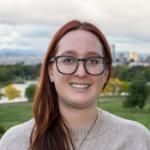
Humans of CIRES: Alejandro Garcia
2026 RECCS intern researched atmospheric boundary layer
Spotlight

Alejandro Garcia was a 2026 intern with the Research Experience for Community College Students (RECCS) program, led by the CIRES Center for Education, Engagement, and Evaluation (CEEE). This summer, Garcia studied the atmospheric boundary layer in the Integrated Remote and In-Situ Sensing (IRISS) lab. He recently graduated summa cum laude from Front Range Community College, and will be transferring to the Colorado School of Mines this fall to study electrical engineering. Garcia is a first-generation college student from Guatemala — and he competed with Guatemala's National Badminton Federation at both the national and international level from 2018 to 2023.


Humans of CIRES Q&A
What did you study with the RECCS program?
I was an intern in the Integrated Remote and In-Situ Sensing (IRISS) Lab, working with Mobile Uncrewed Systems for Atmospheric Science (MUSAS) data and researching the atmospheric boundary layer. My RECCS project compared flight data from RAAVEN, MUSAS's fixed-wing uncrewed aircraft system, to meteorological tower observations from NCAR's Integrated Surface Flux System at the Marshall Field Site in Boulder, Colorado.
What is your educational background?
I recently graduated summa cum laude from Front Range Community College with an Associate of Engineering Science in electrical engineering. I'm a first-generation college student from Guatemala, my family moved to Colorado in 2024. From a young age, I've been fascinated by science and how technology can transform everyday life, which shaped my academic journey, from competing in international STEM competitions, including winning a bronze medal at the Ibero-American Biology Olympiad, to keeping a 4.0 GPA at FRCC. This fall, I'll transfer to Colorado School of Mines to pursue a bachelor's in electrical engineering, with plans for a master's in embedded systems.
Tell us about a hobby of yours.
Back in Guatemala, I used to play badminton competitively, it's actually the fastest racquet sport in the world. I've played since I was in high school, representing Guatemala's National Badminton Federation at both the national and international level from 2018 to 2023. These days it's more of a hobby. It's taught me a lot, discipline, teamwork, and how to stay consistent through the training process. It's both a physical and mental sport, with a lot of strategy and tactics involved.
What book could you read over and over again?
"The Man Who Counted" by Malba Tahan. It follows Beremiz Samir, a traveler who solves seemingly impossible problems using pure logic and creative reasoning rather than rote calculation. The book also carries a philosophy I've carried into my own life: add the good experiences, subtract the obstacles, divide and share your joy with others, and multiply your impact wherever you go. I would read it again and again because of its clever wit, memorable passages, vivid characters, and mathematical puzzles.
What are some of your proudest accomplishments?
I'm a proud member of the Phi Theta Kappa Honor Society. My passion for science has also earned me some international recognition, including third place at the regional NASA International Space Apps Challenge 2023 in Guatemala and first place in a regional Ballistic Rocket Competition. At FRCC, I served as Secretary of the Engineering Club and Captain of the NASA Colorado Space Grant Consortium Robotics Challenge team, where I led the design and programming of a bio-inspired hexapod autonomous rover. In 2023, I founded the Academic Community of Exact Sciences in Guatemala, a student-led network that now serves over 500 college students through 14 study groups in math and physics, a project that reflects my belief that education is most powerful when driven by community and collaboration.