Machine learning helps scientists detect glacial lake outburst floods in Greenland
New method developed at CIRES helps glaciologists understand how and when these climate hazards occur

A CIRES graduate student is developing machine learning methods to detect glacial lake outburst floods from ice-marginal lakes along the Greenland Ice Sheet, work that will ultimately advance the study of this significantly under-researched climate hazard.
Ethan Carr, a CIRES graduate student researcher at the National Snow and Ice Data Center, will present preliminary results of his method development tomorrow, December 18, at the 2025 AGU Annual Meeting in New Orleans. Carr’s work will help glaciologists understand how and when glacial lake outburst floods occur near the Greenland Ice Sheet and what effects they have on the surrounding landscape.
“This is a major part of the terrestrial meltwater storage from the Greenland Ice Sheet, and could carry a significant amount of sea level rise with it, along with other social and environmental impacts,” Carr said.
Greenland is home to more than 3,000 ice marginal lakes: pools of meltwater trapped by glaciers that have dammed river valleys or depressions. Glacial lake outburst floods (GLOFs) happen when those dams break and release catastrophic floods of meltwater. Juneau, Alaska experienced a record-breaking GLOF from the Mendenhall Glacier in August 2025 that dominated national news and forced many city residents to evacuate.
GLOFs are well-studied in glaciated alpine regions like the Himalayas and Andes, but methods for detecting them don’t work well in Greenland. Thanks to its high latitude, the angle of the Sun is low in Greenland, making it more difficult to distinguish water from glacial ice and rock in satellite imagery.

A glacial lake outburst flood in Alaska
An ice-marginal lake near Juneau, Alaska, that experienced a glacial lake outburst flood in August 2025. Photo: Tarek Husevold.
Carr began looking into GLOFs in Greenland while getting his master’s degree. He manually analyzed satellite images of 47 ice marginal lakes in Greenland and identified 552 GLOF events that had occurred in those lakes from 1992 to 2020. Previously, there had been only 57 GLOFs ever documented in Greenland during that time period.
Carr then set out to automate the detection of GLOFs for all of Greenland’s ice marginal lakes. His goal was to find an accurate and precise way of using satellite imagery to monitor the surface area of ice marginal lakes throughout the year and especially during the melt season of May through October.
The optimal method, according to Carr, would need to reliably identify water from surrounding land, glacial ice, and debris-covered ice in satellite imagery where the angle of the Sun is low.
Carr developed 28 different machine learning methods to see which performed best at detecting GLOFs from Landsat imagery. He then compared his machine learning methods to existing indices for detecting water and ice that work well at lower latitudes.
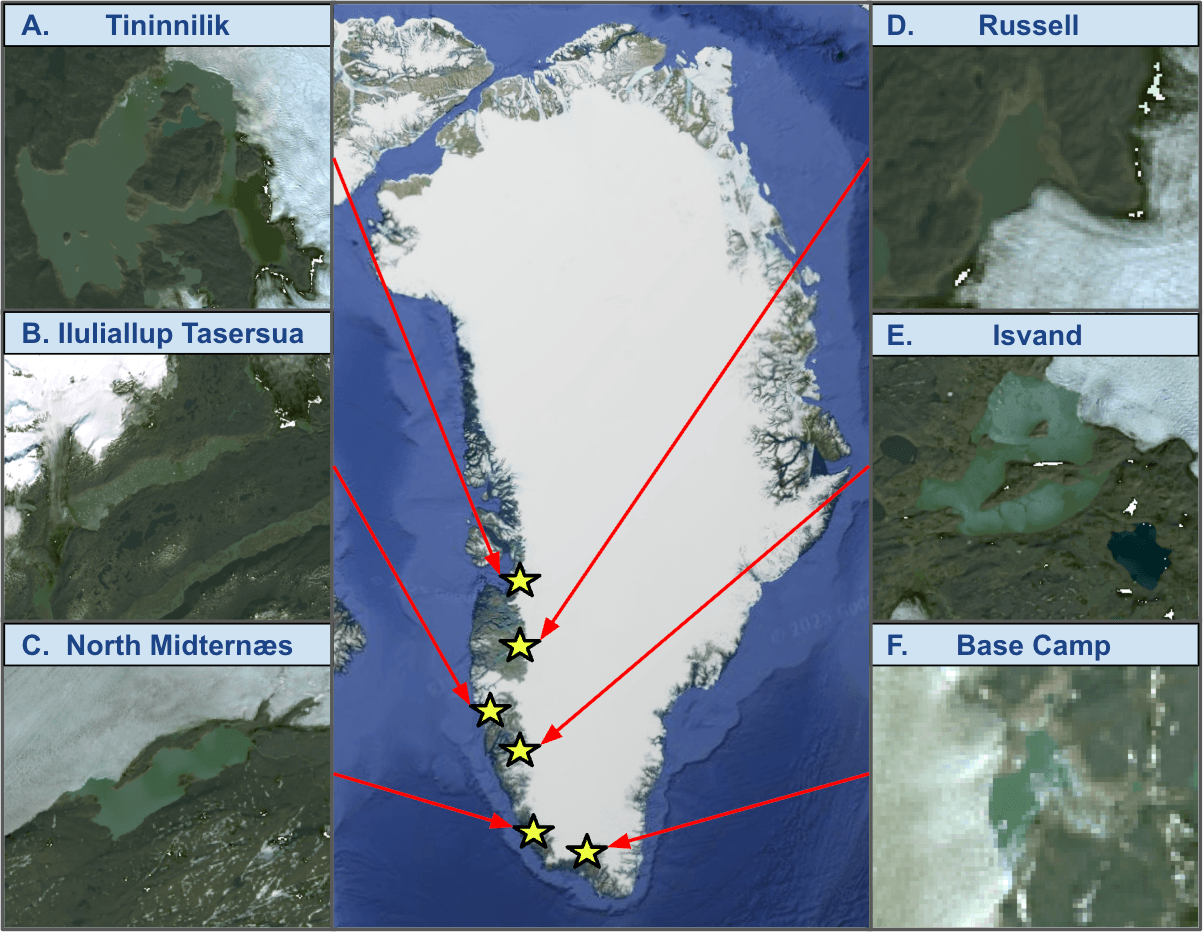
Ice-marginal lakes in Greenland
Satellite imagery of several ice-marginal lakes Carr studied in his recent work. Credit: Ethan Carr.
Carr’s results show his machine learning methods can accurately identify GLOF events in Greenland. In fact, his new methods outperformed all the existing indices for detecting GLOFs in other areas of the world. His next step will be to apply the most effective machine learning method to track GLOFs for all of Greenland’s 3,000+ ice-marginal lakes throughout the Landsat era (1972 to the present).
Carr hopes to find out if GLOFs are becoming more frequent with climate change and what implications this could have on sea level rise. GLOFs could even affect retreat of the ice sheet itself.
“If that's the case, it would be a fairly significant part of the Greenland Ice Sheet system that has been left out of major climate change and glacial retreat simulations,” he said.
Carr will present the results today (Wednesday, December 17, 2025) in a poster session from 8:30 am to 12 pm CST at AGU25. The work has not yet been published.